
What’s Not Included in Any Software Package
Four organizations and one practice that figured this out — and what they built instead.

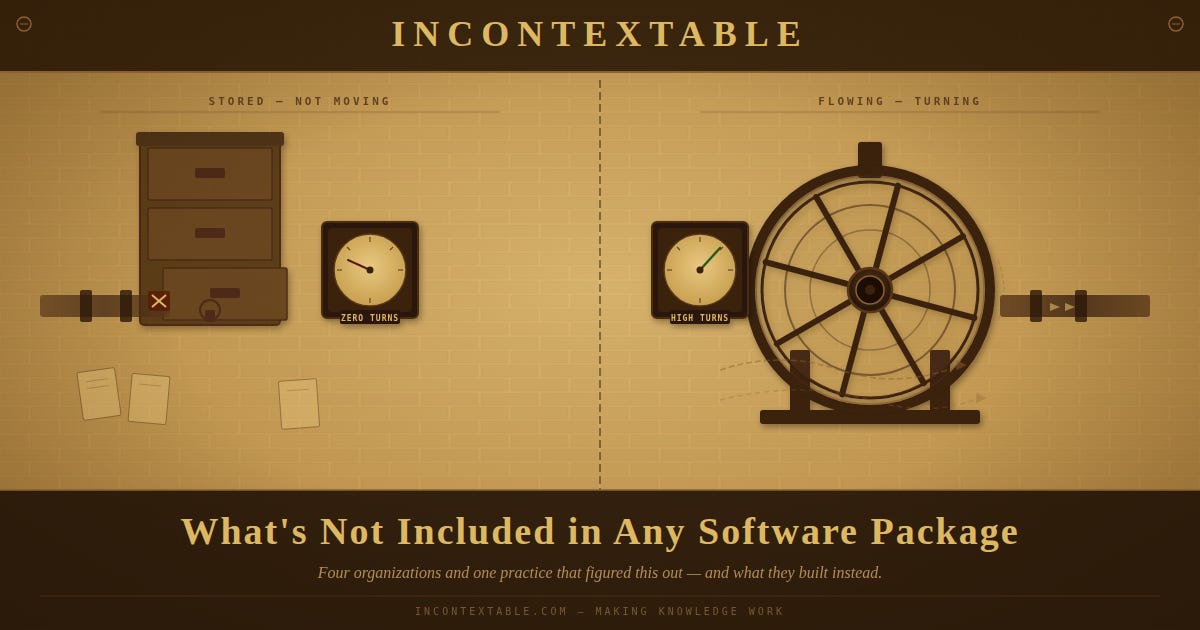
Amazon didn’t solve its meeting problem by buying better meeting software. Netflix didn’t solve its management problem by building better approval workflows. 37Signals didn’t solve its communication problem by adopting a better messaging tool.
They solved it by redesigning how knowledge flows in their organization.
Gary Klein — a cognitive psychologist who spent decades studying how experts make decisions under pressure — gave every organization a thirty-minute practice that does the same thing.
The question most organizations avoid: does the right understanding actually exist in the right person at the right moment — or does everyone assume it does?
Most organizations never ask. They buy another tool instead.
Here is what four organizations did when they asked it — and one practice any organization can adopt tomorrow.
Amazon: Paragraphs Rather Than Bullet Points
In 2004 Jeff Bezos banned PowerPoint at Amazon’s senior leadership meetings.
This is usually described as a quirky management preference. It was something else entirely.
A presentation puts the understanding in the room during the meeting. The presenter knows the material. The audience receives it in real time, processes it imperfectly, asks questions from incomplete comprehension, and makes decisions from whatever partial understanding they managed to construct in fifty minutes.
A six-page narrative memo puts the understanding in the room before the meeting. The first twenty minutes of every Amazon leadership meeting is silent reading. The writer has to achieve clarity before the meeting because the room will notice if they haven’t. The readers have to achieve comprehension before they speak because their questions will reveal whether they did.
The meeting doesn’t create understanding. The meeting uses understanding that already exists.
Amazon added a second practice on the same principle. Before any significant product is built, a team writes a press release for it — as if the product already existed and was being announced to the world. Then a FAQ: every question a customer might ask, every objection a stakeholder might raise, every problem implementation might encounter. Only after the press release and FAQ exist does development begin.
This is called Working Backwards. It forces the understanding of what success looks like — and what the obstacles are — to exist before resources are committed.
Amazon also distinguishes between reversible and irreversible decisions and moves them at different speeds. Reversible decisions move quickly. Irreversible ones get more time, more scrutiny, more people whose understanding needs to exist before the commitment is made.
37Signals: Eliminating the Demand for Unnecessary Flow
Most organizations treat the speed of communication as a proxy for the quality of collaboration. If people are responding quickly, they must be working well together. This assumption generates a specific kind of noise — the expectation of real-time availability, the ASAP culture, the meeting that could have been an email, the email that could have been nothing.
37Signals eliminated it. No ASAP. No expectation of immediate response. Asynchronous communication as the default. People do the work and communicate when they have something worth communicating.
It is a redesign of what knowledge flow is required in the first place. When you remove the expectation of real-time response you remove the noise that was masquerading as communication. What remains is the signal — the thinking that actually needed to travel from one person to another.
The insight is subtractive. Organizations systematically undervalue subtraction — we add tools, processes, communication channels, meetings, and rarely ask what should be removed. 37Signals asked the question and found that most of what organizations call communication is actually interference with the knowledge flow that matters.
Better design. No new tools.
Netflix: Context Instead of Control
Reed Hastings at Netflix described their management philosophy in a phrase that sounds simple and is radical: context, not control.
Most organizations manage information flow through approval systems. Decisions travel up the hierarchy for authorization. Information travels down as directive. The knowledge that would enable good decisions at the front line is filtered through layers that each add latency and remove context.
Netflix inverted this. Instead of building better approval workflows, they invested in making sure the people making decisions had enough understanding of the organization’s goals, constraints, and priorities to decide well independently. The management job was not to control decisions but to ensure understanding existed in the right place.
Instead of routing decisions upward for approval — which treats knowledge as something that lives at the top — Netflix routes understanding downward continuously so that knowledge lives where decisions are made.
No approval software required.
Bridgewater: Making Reasoning Visible
Ray Dalio at Bridgewater Associates built radical transparency — every meeting recorded, every decision documented with its reasoning, every mistake examined openly.
In most organizations the reasoning behind decisions is invisible. The decision gets made, the outcome gets measured, and if the outcome is bad the organization cannot examine whether the reasoning was flawed because the reasoning was never recorded. The system has the decision. It doesn’t have the thinking.
Bridgewater records the thinking. Which means the thinking can be examined, challenged, and improved. Knowledge turns happen not just on what was decided but on how the decision was made. The organization gets smarter not just about outcomes but about the quality of its own reasoning.
This is expensive and uncomfortable. It is also the only way an organization can improve the quality of its judgment rather than just the efficiency of its processes.
Gary Klein: The Pre-Mortem
Before a project begins, Klein asks teams to imagine it has already failed. Not to worry that it might fail. To assume it did — and ask why.
The knowledge that a project might fail in specific ways exists before the project starts. It lives in the intuitions of experienced people, in memories of similar projects that didn’t work, in quiet concerns nobody is voicing because the momentum is toward optimism and raising concerns reads as not being a team player.
The pre-mortem creates a moment where that knowledge has to flow. The concern that was staying private gets permission to become visible. The understanding that something might go wrong surfaces before it’s too late to act on it.
One structured conversation. Thirty minutes. A room full of knowledge that was present but not flowing, made to flow.
No tool required. A single question asked before the project starts.
What They Have in Common
None of these organizations solved an information technology problem. None of these organizations bought their way out of it.
In each case the organization asked a question most organizations never ask: when does the right understanding need to exist in the right person, and what is currently preventing that?
The information management industry never asked this question because it cannot be answered with a product. You cannot sell the Amazon meeting structure as software. You cannot license the pre-mortem as a platform. The insight is organizational and behavioral — a design problem, not a technology problem.
Better design. Sometimes different tools followed. The tools were never the answer.
The Question Worth Asking
The question is not: how do we manage our information better?
It is: when does the right understanding need to exist in the right person for our decisions to go well, and what is currently in the way?
Amazon asked it in 2004 and banned PowerPoint. Netflix asked it and dismantled their approval hierarchy. Klein asked it and invented a thirty-minute conversation.
The tools exist to support whatever answer you find. They always did.
Most organizations are still waiting for someone to sell them the answer as software.
“Tell me how you measure me, and I will tell you how I will behave. If you measure me in an illogical way, don’t complain about illogical behaviour.”
— Eliyahu Goldratt, The Haystack Syndrome
The knowledge flow problem is largely invisible. That’s part of why it stays unsolved.
K-TIP 01: Amazon’s Six-Pager — Paragraphs Rather Than Bullet Points
Knowledge Turns in Practice — one organization, one practice, one question.
The Practice
Every significant meeting at Amazon begins with twenty minutes of silent reading. No presentation. No slides. A six-page narrative document — written in complete sentences, no bullet points — is distributed at the start of the meeting. Attendees read it before any discussion begins.
The writer must achieve clarity before the meeting because the room will notice if they haven’t. Readers must achieve comprehension before they speak because their questions will reveal whether they did.
Jeff Bezos introduced this in 2004. His description was simple: a presentation is easy for the presenter and hard for the audience. A narrative memo is hard for the writer and generative for the room.
What It Actually Does
The six-pager is not a document format. It is a knowledge turn built into the meeting structure.
In a standard meeting, understanding is supposed to emerge during the discussion. In practice it rarely does — people arrive with different levels of context, discussions are dominated by whoever speaks most confidently, and decisions get made from whatever partial comprehension the room assembled in real time.
The six-pager forces the knowledge turn before the meeting. The floor of shared understanding when discussion begins is higher than any presentation produces.
Amazon reports getting roughly twenty times as much information processed in the same meeting time — not because the document is longer, but because the understanding exists before the conversation starts.
The Question It Asks
In your organization, when does the understanding needed for this decision actually have to exist — and does it?
Most meetings assume understanding will emerge during discussion. The six-pager assumes it has to exist before. That assumption changes how you prepare and what the meeting is actually for.