
What Everyone Has Wrong About Project Management and Budgeting
Variability is Information

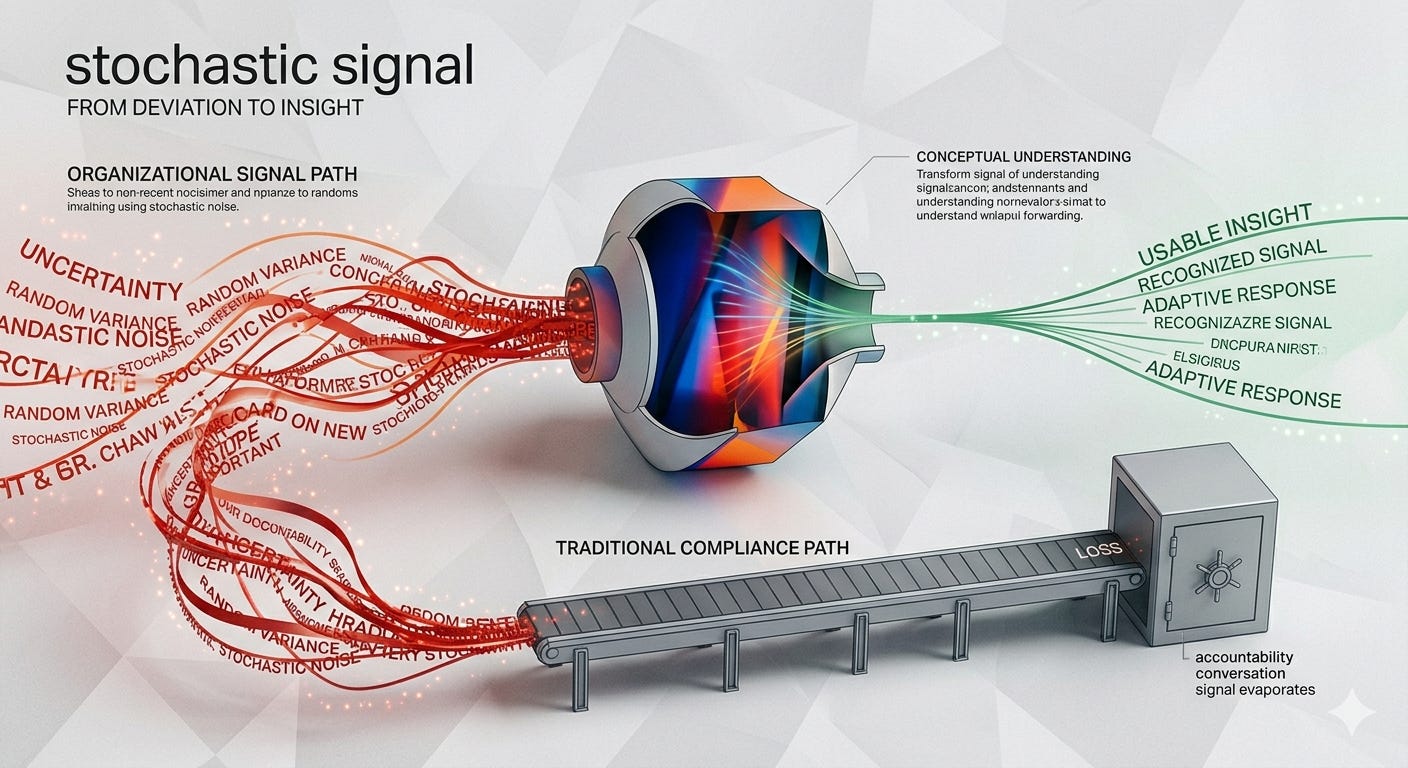
When a project falls behind schedule the response is almost always some version of better planning next time. When a budget drifts the response is tighter controls. Both responses are reasonable. Neither addresses what actually happened.
What actually happened is that reality generated information the plan didn't anticipate. This is not a planning failure. It is what reality does. The question isn't whether your project plan or your budget will encounter unexpected information — they will — it's whether your organization has any capacity to receive it.
Most don't. Not because they lack intelligence or discipline, but because the systems built around plans and budgets are designed to measure conformance, not process signal. The variance report asks how far you are from the number. It does not ask what the variance is trying to tell you.
This is the same problem running in two places simultaneously. The project that's three weeks behind schedule and the department that's twelve percent over budget are both generating stochastic signal in a system architected for linear flow. The organization responds by tightening the linear system. The signal goes unread.
Plans and budgets aren't prediction instruments that sometimes fail. They're contrast media — their job is to make deviation visible, not to prevent it. The plan doesn't tell you where you'll end up. It gives you a stable enough baseline that you can recognize when something unexpected is happening and ask why. The budget doesn't control spending. It makes anomalies legible.
Most organizations have this exactly backwards. Which is why they're very good at defending numbers and remarkably poor at reading them.
The organizations that get this right don't have better plans. They have better questions.
When a project slips they don't immediately ask who fell behind. They ask what the slip is telling them about the original assumptions. Was the estimate wrong, or did something change? If something changed, is it local to this project or visible across others? The schedule deviation is the beginning of an inquiry, not the end of one.
The same with budgets. The department running twelve percent over isn't necessarily out of control. It may be responding rationally to something the budget cycle couldn't have anticipated. The question is whether the organization can tell the difference — and whether it has created conditions where the honest answer is safe to give.
This is what high knowledge turns looks like in practice. Not faster reporting. Not better dashboards. The conversion rate of deviation into understanding. How much of what the work is telling you actually reaches the people who can act on it, in a form they can use, before it's too late to matter.
Most organizations have a conversion rate close to zero. The deviation gets logged. The variance gets explained. The explanation gets accepted or challenged. The underlying signal evaporates in the accountability conversation.
The project ends. The budget closes. The postmortem, if there is one, arrives too late to change anything. Everyone agrees on lessons learned. The same lessons surface twelve months later.
The reason this persists is that better planning is a legible response and reading stochastic signal is not. You can mandate earlier kickoffs, more detailed work breakdown structures, monthly budget reviews, tighter approval thresholds. These are visible management actions. They produce artifacts. They signal seriousness.
Building an organization that can receive and metabolize unexpected information requires something harder to mandate: a different relationship with deviation. One where variance isn't primarily an accountability event. Where the person closest to the anomaly is expected to surface it, not manage it away. Where the plan and the budget are held lightly enough that they can do their actual job.
That's not a process change. It's a cognitive one. Which is why it doesn't appear in the project management methodology and doesn't show up as a line item in the budget software.
You will plan your next project. You will build your next budget. Both are worth doing. The plan creates shared orientation. The budget creates shared constraint. Without them you don't have stochastic signal — you just have noise.
But at some point the work will begin generating information your plan didn't anticipate. The only question worth sitting with isn't how to prevent that.
It's what your organization actually does when it arrives.