
The End of the Meaningless Acronym
CRM. ERP. HCM. LMS. SCM. KM. Named for the Aspiration, Built to the Limits of Technology at the Time

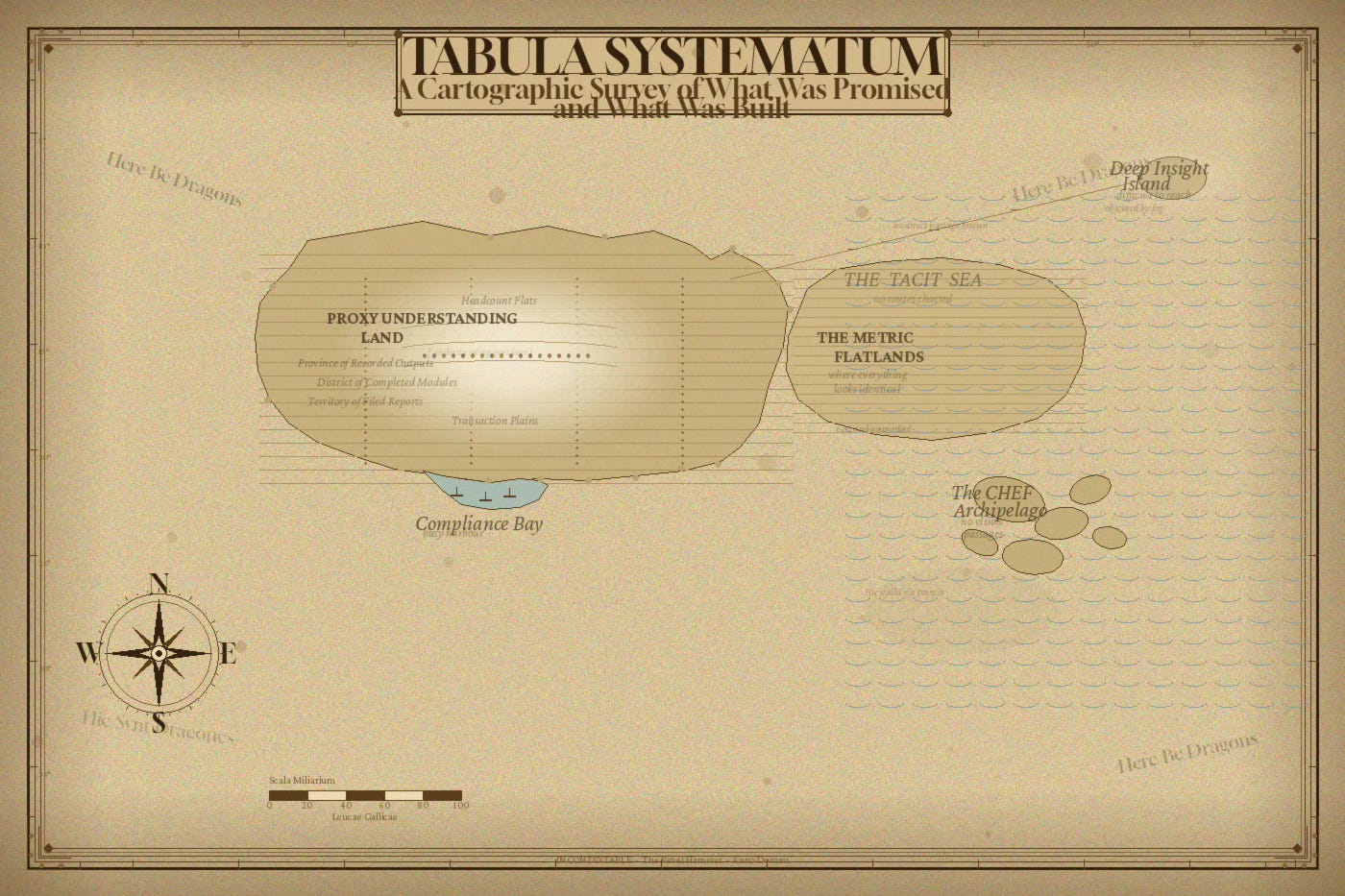
Sometime in the last thirty years, the enterprise software industry developed a habit of naming its products after the organizational capabilities they were supposed to deliver.
Customer Relationship Management (CRM). Enterprise Resource Planning (ERP). Human Capital Management (HCM). Learning Management System (LMS). Supply Chain Management (SC). Knowledge Management (KM).
Every one of those names describes something that, if an organization actually had it, would change how the business performed. Every one of those names was then attached to a system that delivered something considerably more modest and considerably more expensive.
The names outlasted the ambitions. The acronyms became the territory — and everyone forgot there was ever a map.
Take them one at a time.
Customer Relationship Management. The name suggests an organization that understands its customers — what they actually need, how the relationship is developing, when it is deepening or cooling. A system worthy of the name would know a key account is at risk before the revenue signal appears. It would carry the context of every interaction in a way that made the next person as effective as the last.
What the CRM actually does is record what salespeople are willing to type after meetings they have already had. It captures the transaction, not the relationship. It stores the history, not the understanding.
When that person leaves, the relationship doesn’t transfer. The data transfers. The data is not the relationship.
Enterprise Resource Planning. The name suggests an organization that actually plans — that looks across its resources and makes coherent decisions about allocation before commitments become crises.
What the ERP actually does is track resource consumption after decisions have already been made. It is the most expensive rearview mirror ever built. The ERP knows what happened. It rarely knows why. It has no opinion about whether it was a good idea.
Learning Management System. The name suggests an organization that understands what its people know, what they need to know, and whether the investment in development is producing genuine capability.
What the LMS actually does is track completion. It measures whether the course was clicked through, not whether anything changed in how someone thinks or works. It produces a compliance report that proves learning happened. It has no mechanism for detecting whether it did.
The Learning Management System is how organizations prove that learning is happening without having to check whether it is.
Human Capital Management. The name — setting aside the question of whether people should be called capital, which is worth its own essay — suggests an organization that understands the human capabilities it has, how they are developing, where they are underutilized.
What the HCM actually does is store org charts, process payroll, and generate reports on headcount and attrition. The actual person — with specific knowledge, specific relationships, specific judgment that took years to develop — appears in the system as a job title, a salary band, and a performance rating from one annual cycle. The capital is not managed. It is catalogued.
Knowledge Management. The name promises a system for capturing, preserving, and applying what the organization actually knows — the accumulated understanding that shouldn’t evaporate when people leave.
What knowledge management systems actually manage is documents. Wikis that nobody updates. Intranets that nobody visits. The knowledge — the tacit understanding that lives in practice and judgment — was never in the system. No search function will surface what was never captured. No SharePoint implementation will preserve what lives in the experienced judgment of the person who just retired.
The pattern is the same each time.
Each system was designed before anyone fully understood what delivering the capability would actually require. The technology could automate what was automatable. The parts that actually mattered couldn’t be automated. So the automatable parts became the system and the system became the name.
The measurable thing became the system. The name described the goal. The system captured the proxies. The proxies became the metrics. The metrics became the reality.
The approximation got sold as the thing. The thing was forgotten. The approximation accumulated thirty years of configurations, customizations, and integrations.
And here we are.
The tools that could actually close the gap are arriving now — but the question is what they get pointed at.
Not AI as a feature layered onto the existing system — Salesforce Einstein, SAP Joule, the AI assistant bolted onto the product that was already doing the wrong thing. That is the approximation updated with a chatbot. The gap is still there. The thirty years of accumulated configuration are still underneath.
The genuine opportunity is to ask what the name actually promised before deciding what to build. The CRM that knew a relationship was cooling before the revenue signal appeared. The LMS that knew whether capability changed, not whether a module was completed. The Knowledge Management system that made the why as recoverable as the what.
None of this requires magic. It requires asking what the system was named after and building toward that rather than toward the proxy that was technically feasible in the previous era.
Every organization making AI investment decisions is choosing between two approaches. Add AI to the existing systems — the ones named after aspirations they never delivered, optimized for proxies that were never the real thing. Or ask what the names always promised, and build toward that before deciding what the AI layer sits on top of.
The first approach produces faster approximations. The second produces the thing the name was always promising.
One of these is more expensive to start. One is more expensive in the end.
CHEF is not an aspiration. It is a diagnosis — a name for what something became. That is a different kind of name.
Incontextable is a publication about organizational knowledge, technology design, and why the gap between the two keeps getting wider.