
The Big Lie of Big Data: That the Business Still Makes Sense
Why lack of coherence is more dangerous than missing data

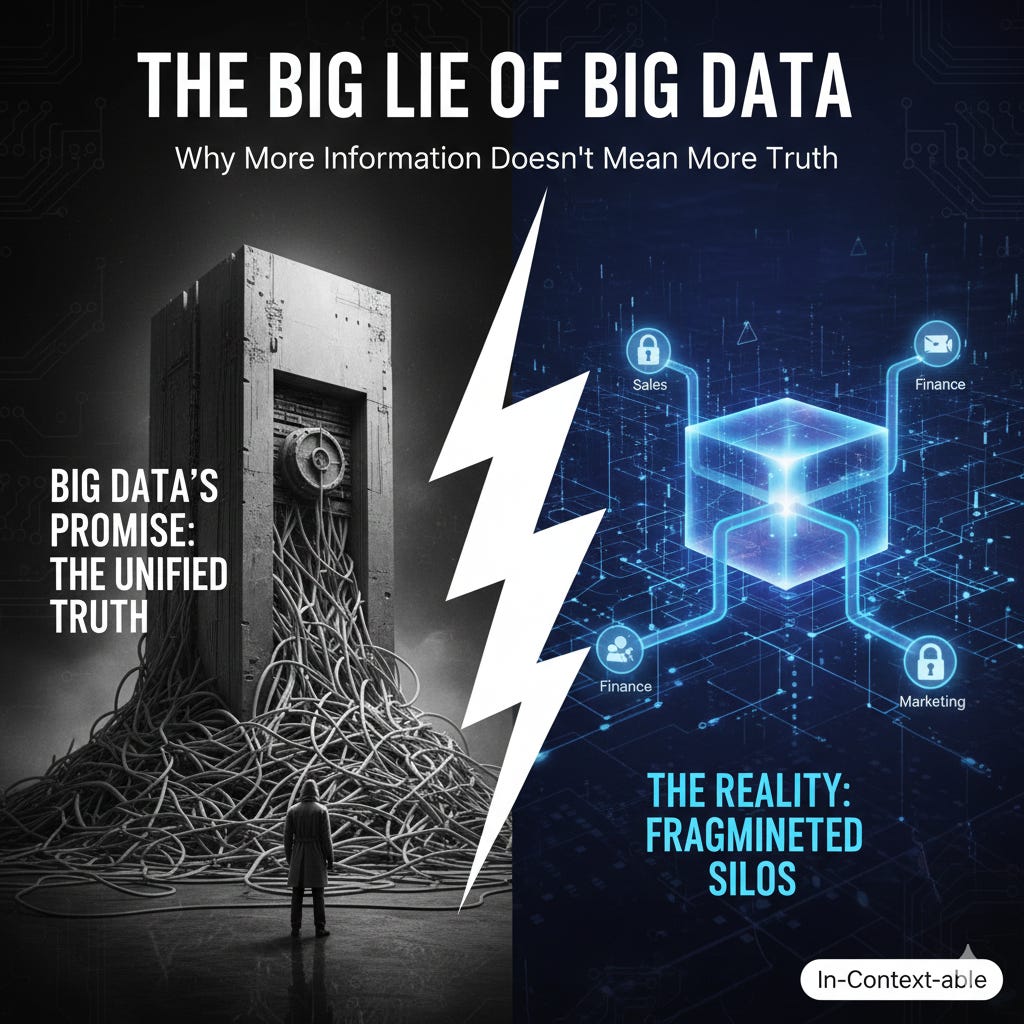
For decades, people inside organizations have complained about the same thing:
“The systems don’t really understand the business.”
This used to be a mundane grievance.
IT systems were rigid.
Business reality was messy.
Everyone knew there was a gap.
That gap was frustrating—but it was also visible.
We knew where the conflicts lived. What’s changed is not that the problem was solved. What’s changed is that we now pretend it no longer exists.
From “Systems Don’t Understand the Business” to “The Business Is the System or even more damaging the System is the Business.” Somewhere along the way, a quiet inversion happened.
We stopped saying:
“The system models part of the business.”
And started assuming:
“The business rules live in the system.”
This assumption now underpins:
Big data platforms
ERP suites
CRMs
Workflow engines
AI models
Analytics stacks
“Single source of truth” initiatives
The modern organization behaves as if:
If the data is integrated,and the pipelines are connected, and the dashboards agree, then the business logic must be coherent.
That belief is the big lie.
Integration Replaced Understanding
Big data promised something intoxicating:
Capture everything
Connect everything
Analyze everything
Decide faster
What it quietly displaced was something far more important: shared interpretation.
Business rules used to live in:
people’s heads
conversations
judgment calls
exceptions
tacit knowledge
institutional memory
They were messy, but they were socially coherent.
Now those rules are assumed to live in:
schemas
transformations
pipelines
metrics definitions
feature flags
AI prompts
configuration tables
The rules didn’t become clearer. They became implicit.
The Coherence Assumption
Modern systems are built on an unspoken premise:
“If logic is distributed across systems, it will still behave like a unified logic.”
This is almost never true.
Instead, what we get is:
Local correctness
Global contradiction
Rational subsystems producing irrational out comes
Each system is internally consistent. The organization as a whole is not. And because everything is “technically correct,” no one feels authorized to question the result.
Big Data Didn’t Eliminate Ambiguity, It Fragmented It
In the past, ambiguity lived in people.
Now it lives in:
mismatched definitions
silent assumptions
transformation layers no one owns
logic encoded once and reused everywhere
dashboards that look precise and mean different things
The ambiguity didn’t go away. It was atomized.
And atomized ambiguity is harder to see, harder to challenge, and harder to fix.
This is why organizations experience:
metric wars
dashboard distrust
endless reconciliation meetings
“why don’t these numbers match?” fatigue
AI outputs that are plausible and wrong
The system isn’t lying. It’s incoherent.
Why We Stay in Denial
We don’t deny this problem because we’re stupid. We deny it because acknowledging it would mean admitting:
The business does not actually have a single, stable logic
“Single source of truth” is an aspiration, not a state
Integration does not equal understanding
Automation is outrunning interpretation
AI is amplifying ambiguity, not resolving it
That’s uncomfortable.
So instead, we:
Add more governance
Add more tooling
Add more dashboards
Add more layers of abstraction
Each layer increases distance from meaning while creating the illusion of control.
The AI Acceleration Problem
AI makes this much worse.
AI systems assume:
the data represents reality
the rules are consistent
the labels mean what they say
the past logic is still valid
But AI doesn’t know when:
a metric changed meaning
a workaround became policy
an exception became the norm
a definition drifted quietly
a business rule was socially renegotiated
AI consumes artifacts. Business logic lives in interpretation.
That gap is now the most dangerous one in the organization.
Coherence Is Not a Data Problem
This is the key distinction:
Data problems can be solved with tooling
Coherence problems cannot
Coherence means:
the same signals mean the same thing across contexts
decisions made in one system don’t contradict another
humans can explain why outcomes occurred
assumptions are visible and challengeable
change doesn’t silently break meaning
No amount of integration guarantees this. In fact, integration often hides its absence. )
What We Actually Need (and Rarely Build
Organizations don’t need:
more data
more integration
more automation
more AI
They need:
places where meaning is negotiated
explicit ownership of assumptions
shared models of how the business works
systems designed for legibility, not just efficiency
friction where interpretation matters
This is slow work. It doesn’t demo well.
But without it, we are building faster and faster systems on top of an increasingly unstable understanding of reality.
The Line We Keep Refusing to Cross
As long as we pretend:
“The business rules live coherently in the system” we will continue to be surprised by outcomes that were perfectly predictable—if only anyone could still see the whole.
Big data didn’t fail because it lacked power. It failed because it replaced shared understanding with silent, distributed assumptions.
And until we face that honestly, we will keep mistaking integration for coherence and speed for sense.