
Knowledge Turns: The Metric We Never Built for Knowledge Work
The Organizational Entropy Problem Nobody Is Measuring

In the 1990s I worked alongside people who were trying to do something genuinely difficult — measure knowledge work the way manufacturing had been measured. The lean revolution had given us inventory turns, cycle time, throughput, work in progress. These were precise, actionable, honest. They told you exactly how well your factory was working and exactly where it was failing.
Knowledge work resisted every attempt at the same precision. The metrics that emerged — headcount, hours logged, tickets closed, documents filed — measured the wrong thing. They measured storage, not flow. Accumulation, not application. They told you how much knowledge you had. They said nothing about whether any of it was working.
We never built the right metric. We still haven’t. But the concept existed then and it exists now, and it’s more urgent than it’s ever been.
I want to propose one. Call it the Knowledge Turn.
————————
What Inventory Turns Actually Measure
In lean manufacturing, inventory turns tell you how fast stock moves through the system. High turns mean lean operations — material flows quickly from intake to production to customer. Low turns mean waste — stock sits, ties up capital, drifts toward obsolescence.
The insight behind the metric is simple: inventory that isn’t moving isn’t working. It’s just occupying space and costing money while pretending to be an asset.
Knowledge works the same way. Knowledge that isn’t moving — that sits in a database, a documentation system, a ticketing archive — isn’t working. It’s occupying server space and costing attention while pretending to be organizational intelligence.
The difference is that unlike inventory, knowledge doesn’t get consumed when it’s used. A part that gets installed is gone. A piece of knowledge that gets applied can be applied again — refined, updated, passed forward. Knowledge that turns well doesn’t deplete. It compounds.
Which makes low knowledge turns not just wasteful but compounding in the wrong direction. Every piece of knowledge that sits unused drifts toward entropy. It carries assumptions that decay. It reflects a moment in time that has passed. It hardens into something that looks like truth but is actually an artifact of a previous reality.
————————
The Physics of Organizational Entropy
Entropy is the default state. Without active energy input, systems drift toward disorder. This is true of physical systems and it is true of knowledge systems.
Every organization is fighting entropy whether it knows it or not. The question is whether it’s fighting it effectively or just generating the appearance of fighting it.
Most knowledge management systems generate the appearance. They capture. They file. They organize. They produce dashboards showing how much has been captured, filed, and organized. What they don’t measure — what they have no mechanism to measure — is whether any of it is actually working against entropy or merely encoding it at higher resolution.
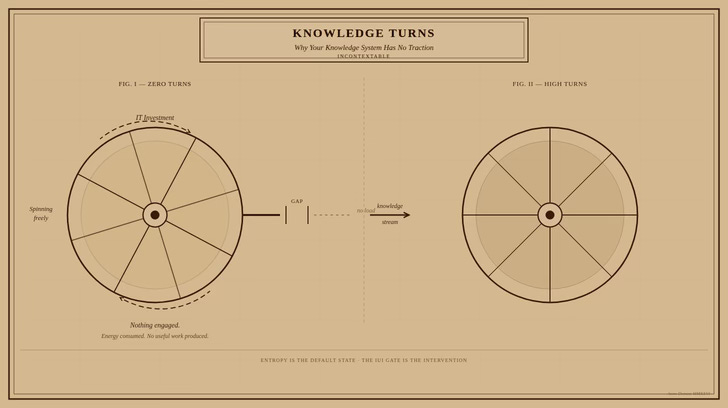
A knowledge system with zero turns is a particularly expensive form of entropy. It gives the organization the confidence of having captured something without the benefit of having used it. It produces the illusion of organizational memory while the actual memory decays underneath.
Richard Feynman understood this. Reality must take precedence over public relations, for nature cannot be fooled. Entropy doesn’t care how well documented it is.
————————
The Knowledge Turn Defined
A Knowledge Turn is the complete cycle of:
Capturing a piece of context — not just information, but the conditions under which it applies.
Refining it into a signal — removing noise, surfacing what actually matters for a specific purpose.
Applying it to a problem — the moment the knowledge does actual work.
Archiving and updating it for the next person — with the context of how it performed and what changed.
An organization with high knowledge turns moves knowledge quickly from capture to application to update. Each cycle makes the knowledge more accurate, more contextual, more useful. The system gets smarter over time.
An organization with zero knowledge turns has knowledge storage. It piles up documentation like a digital hoarder — everything captured, nothing refined, nothing applied, nothing updated. The technicians eventually stop consulting it and start guessing. Which is rational. The knowledge system has made guessing more efficient than retrieval.
————————
The Information Utility Index as the Velocity Engine
This is where the Information Utility Index becomes useful as something more than a diagnostic framework.
The IUI asks two questions about any piece of knowledge: is it accurate, and is it useful? The resulting matrix has four quadrants. Intelligence — accurate and useful. The Data Lake — accurate and useless. The Working Map — inaccurate but useful. Noise — inaccurate and useless.
Most organizational knowledge management optimizes for the wrong quadrant. It pursues accuracy obsessively — more data, better data, cleaner data — without asking whether the accurate data is doing any work. The result is an organization full of Data Lakes. Accurate. Useless. Zero turns.
The IUI reframes the goal. The objective isn’t accuracy for its own sake. It’s utility — knowledge that actually moves through the system, gets applied, gets refined. Directionally correct beats precisely wrong. A working map that gets used beats a perfect map that sits in the archive.
High IUI means high knowledge turns. The knowledge is moving. It’s being applied. It’s being updated. It’s fighting entropy.
Low IUI means zero knowledge turns. The knowledge is sitting. It’s accurate and inert. It’s encoding entropy at higher resolution.
The IUI is the velocity metric that the knowledge turn requires. You can’t measure turns without measuring whether the knowledge is actually doing work at each stage of the cycle. The IUI tells you whether the knowledge moving through your system is intelligence or just expensive noise.
————————
The Refinery, Not the Warehouse
The metaphor that holds this together is the refinery.
A warehouse stores things. Its job is to keep what goes in intact until something takes it out. Success is measured by capacity and preservation. The warehouse is optimized for accumulation.
A refinery transforms things. Crude input enters, refined output leaves. The value isn’t in the storage — it’s in the transformation. A refinery that stops refining and starts accumulating crude is no longer a refinery. It’s a very expensive warehouse with a fire hazard.
Most organizational knowledge systems are warehouses pretending to be refineries. They take in crude context and store it at crude resolution. The AI layer being bolted on top of most of them is a faster, more confident warehouse. More intake. Better indexing. Same absence of refining.
A genuine knowledge refinery takes in context, removes noise, surfaces signal, applies it where it’s needed, and updates it based on what it learned in application. Each turn through the cycle makes the output more refined. The system doesn’t just store knowledge — it improves it.
That is what knowledge management was always supposed to be. We just never built the metric that would tell us whether we were achieving it.
The Knowledge Turn is that metric. The IUI is the engine that drives it. And entropy is what happens when neither is working — which is, at the moment, the condition of most organizations on earth.
————————