
Friction is a Valuable Filter
Efficiency's Blind Spot

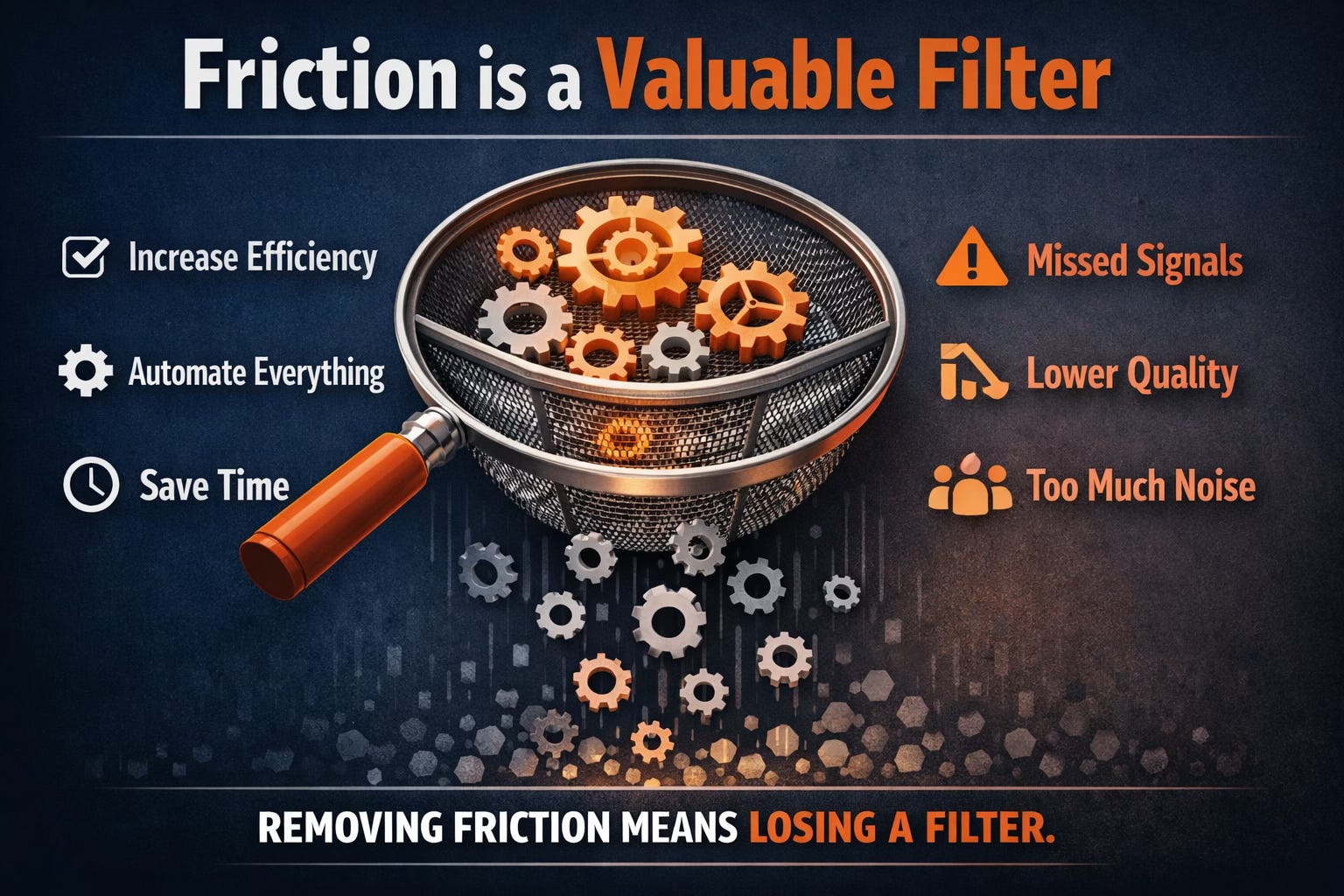
Every productivity platform, every workflow automation, every scheduling tool, every AI assistant is built on the same premise: friction is waste. Remove the steps, reduce the effort, eliminate the awkwardness, smooth the path.
It’s a reasonable assumption in a lot of contexts. But it’s destroying something that most organizations don’t have a name for. Because friction isn’t always waste. Sometimes friction is a filter. And when you optimize away a filter, you don’t just save time. You lose the selection mechanism the friction was providing — and you don’t notice, because the loss is invisible and the efficiency gain is measurable.
————————
What Friction Actually Does
Consider the Calendly link.
Calendly is a scheduling tool that eliminates the back-and-forth of arranging a meeting. You send someone a link, they pick a slot, it appears in both calendars. No negotiation, no awkward emails, no “does Tuesday work for you.” Clean, fast, frictionless.
It’s also, in a precise sense, indiscriminate.
The old process of arranging a meeting — the email, the phone call, the ask — contained information. The effort required to initiate a meeting was roughly proportional to the perceived value of having it. Which meant that meetings which weren’t quite worth the effort of arranging often didn’t get arranged. The friction filtered them out before they consumed anyone’s time.
Calendly removes that filter. The CEO and the cold outreach vendor get the same frictionless access to your calendar. The meeting that would have died in the scheduling process — because actually, when forced to articulate why it needed to happen, neither party could quite do it — now happens, because the path of least resistance made it easy.
This is not a criticism of Calendly specifically. It’s an observation about what happens when you remove friction from a place where friction was doing useful work. You don’t just save time in the scheduling process. You transfer the cost — now paid in the meeting itself, and in every subsequent meeting that results from it, and in the relationships that form around conversations that probably shouldn’t have started.
The efficiency gain is real and measurable. The filter loss is real and invisible.
————————
The Productivity Industry’s Blind Spot
The entire productivity optimization industry is built around a single question: how do we do this faster and with less effort?
It is almost never built around the prior question: should we be doing this at all?
Friction, when it exists in the right places, answers that prior question automatically. The cover letter that requires genuine effort filters for candidates willing to do the work before the interview begins. The budget approval process that requires written justification filters for projects whose proponents believe in them enough to articulate why. The sales process that requires multiple conversations filters for customers who actually need what you’re selling rather than customers who were frictionlessly onboarded and will churn in three months.
In each case, the friction is not an obstacle to value. It is the mechanism by which value gets selected for.
When you automate it away, you don’t eliminate the selection problem. You just move it downstream, where it’s more expensive and more disruptive to resolve.
————————
Toyota Knew This
The most counterintuitive quality control insight in the history of manufacturing was the andon cord.
In a Toyota plant, any worker on the production line could pull a cord to stop the entire line if they spotted a problem. This was deliberate, designed friction introduced into a system that every other manufacturer was trying to make as frictionless as possible. The assumption everywhere else was that stopping the line was waste. Toyota’s assumption was that stopping the line was the mechanism by which quality was preserved.
The friction was the product.
What the andon cord created was a system in which problems surfaced rather than got optimized around. In a frictionless production system, a defect gets passed down the line, incorporated into subsequent steps, and discovered — expensively — at the end. In Toyota’s system, the friction of stopping everything forced the problem to be addressed at the point where it was cheapest to fix.
The insight transfers directly to information and organizational decision making. The meeting that requires a written agenda before it gets scheduled is an andon cord. The approval process that requires someone to articulate the rationale for a decision is an andon cord. The pause before deploying an AI output that requires a human to verify the reasoning is an andon cord.
These are not inefficiencies. They are the mechanisms by which organizational quality gets preserved. And the productivity optimization impulse, applied without judgment, pulls them out one by one.
————————
The Mimicry Problem
Friction also gets eliminated for reasons that have nothing to do with efficiency — through mimicry.
A tool spreads through a professional community not because it solves a problem everyone has but because enough visible people use it that using it becomes a signal of belonging. Calendly is partly this. The bundle of SaaS features nobody uses but everyone pays for is entirely this. The AI summary appended to every document regardless of whether the document needs summarizing is this.
When a tool spreads through mimicry rather than genuine need, it carries whatever frictions it eliminates along with it — into contexts where those frictions were actually serving a purpose. The professional who needed Calendly because they were genuinely managing hundreds of inbound meeting requests is a real person. The professional who got a Calendly link because everyone in their network had one, and now sends it to everyone including people they’re trying to build a relationship with for the first time, has imported a solution to a problem they didn’t have — and exported a filter that was worth keeping.
The question is not whether to use scheduling tools. It’s whether the friction they eliminate was doing useful work in your specific context — or whether you adopted the tool because your peers did, without asking.
————————
Where Friction Belongs
None of this is an argument for making things unnecessarily hard. Friction in the wrong places is genuinely wasteful — the approval process that exists because nobody removed it when the organization changed, the report that gets generated because it always has been, the meeting that happens weekly because it was scheduled to recur.
The discipline is knowing the difference. And that requires asking a question that almost no technology evaluation process ever asks:
What is this friction currently filtering, and do we want to keep filtering for that?
If the friction is filtering for nothing — it’s just inertia, bureaucracy, legacy process — eliminate it. That’s genuine efficiency.
But if the friction is filtering for effort, for seriousness, for genuine need, for the kind of commitment that separates the conversations worth having from the ones that would consume time without creating value — then optimizing it away is not efficiency. It is the removal of a selection mechanism you will miss when it’s gone and won’t be able to name when you’re trying to understand why things feel faster but somehow worse.
————————
The Design Question
This is ultimately a design question, and it belongs upstream of any technology decision.
Design for Manufacturability — the discipline that preceded lean manufacturing — taught engineers that the decisions made earliest in a product’s development had the most leverage over everything downstream. A design that ignored manufacturability created problems that no amount of effort on the factory floor could fully resolve. The leverage was always in the early decisions.
The same principle applies to organizational information design. The decision about where to preserve friction and where to eliminate it is an early, upstream, high-leverage decision. Made well, it shapes what kinds of conversations happen, what kinds of decisions get made carefully, what kinds of relationships form with sufficient investment to be real. Made badly — or not made at all, because the default is always to eliminate friction wherever it appears — it produces organizations that are very fast and very smooth and gradually, invisibly, unable to filter for what matters.
That question requires judgment. Judgment requires pausing. Pausing is, in a small way, friction.
Which is exactly the point.